

Happy (early) International Women’s Day and Women’s History Month from WHPC!
March is a time to celebrate women’s achievements, to educate and learn about women’s history, and to renew our collective commitment to advancing equality, diversity, and inclusion in every aspect of our work and lives. This March, we are unveiling our special edition design celebrating women in HPC, alongside sharing powerful messages of advice, encouragement, and inspiration from across the WHPC community.
Integrated Architectures, Accelerated Impact: celebrating female HPC pioneers for ISC 2026
If you have been following WHPC for a while, you’ll know that we proudly debut a new t-shirt design at ISC and SC every year – and we have had some truly great ones over time! Our shirts are more than just conference swag; they showcase our community to the wider HPC world, to show-off our pride in championing diversity and the strength of our movement. For ISC 2026, we have an extra special design that aligns with this mission to celebrate the remarkable women in our field.
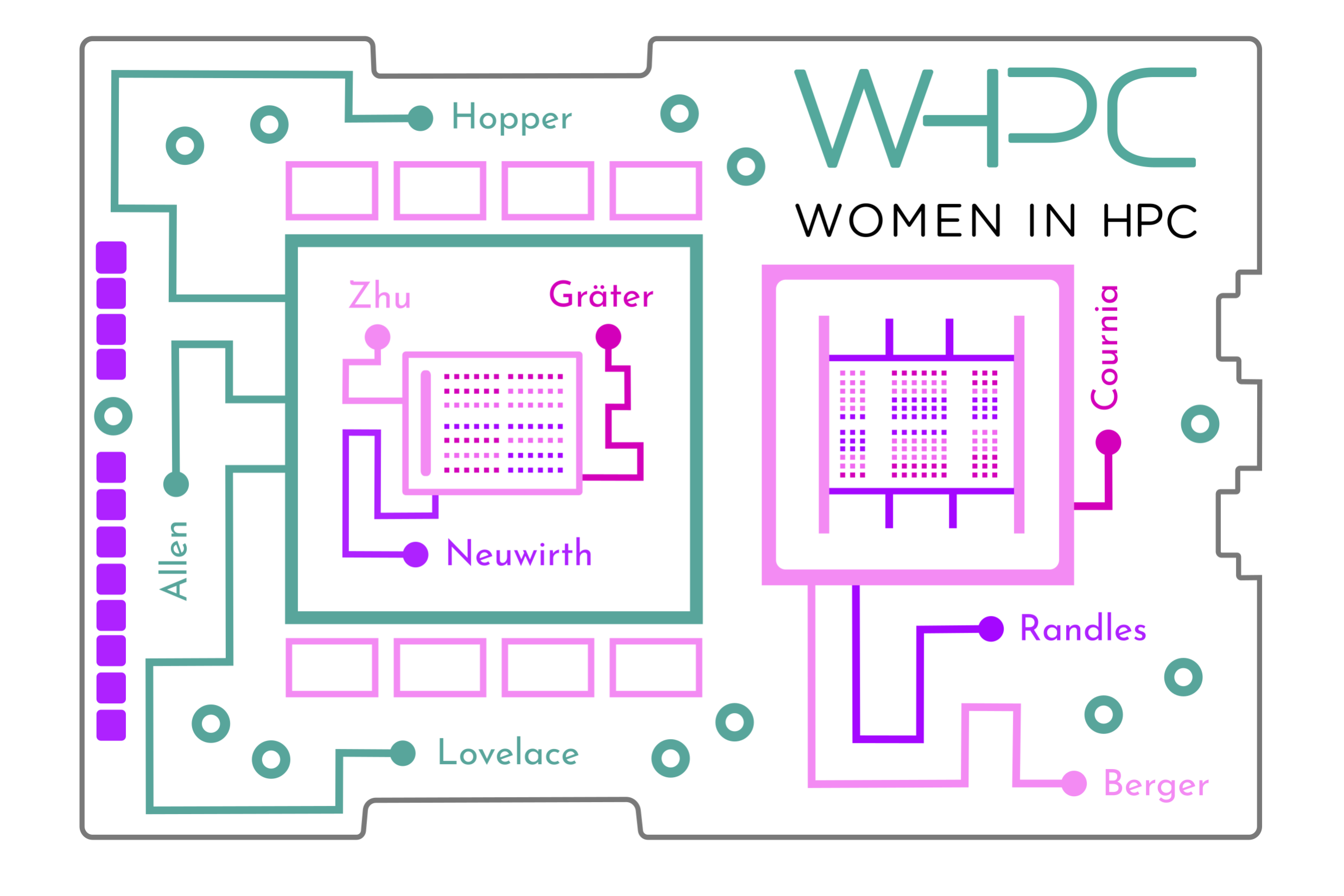
Designed by Dr. Ekaterina Zossimova, this artwork is inspired by heterogeneous processors – a major technological advance in HPC that combines tightly integrated CPUs and GPUs on a single chip. By combining general-purpose processing power from the CPU with highly parallel acceleration from the GPU, these architectures deliver high-performance interconnects, optimised data movement and significantly increased computational throughput to drive our next scientific advances. In recent years, leading HPC vendors have driven this shift to a closer, more integrated system design. For example, El Capitan, the world’s fastest supercomputer according to the November 2025 Top500 list, is powered by AMD MI300A APUs. Meanwhile, JUPITER Boost, ranked at number 4, utilised NVIDIA GH200 Superchips. This demonstrates how such architectures are now central to leadership-class systems.
Famously, NVIDIA named its Grace Hopper Superchip in honour of the pioneering computer scientist Grace Hopper. Hopper developed the first compiler, bridging human-readable code and machine language, a breakthrough that fundamentally changed the future of our field. More than 70 years later, she is recognised as one of the foundational figures of modern computer science.
Ekaterina’s design interweaves the tightly integrated CPU and GPU with the names of influential women in computing whose contributions have shaped our field. This visually demonstrates both the technological evolution of HPC architecture, but also celebrates the women and the impact of their work which is underpinning this innovation.
Discover more about the other women whose names are featured, learn about their inspiring and cutting-edge work, and explore how they are making a difference in our field.
Dr. Amanda Randles
Director of the Duke Center for Computational and Digital Health Innovation;
Recipient of the 2024 Jack Dongarra Early Career Award;
Midweek Keynote Speaker at ISC 2026
There are two moments that stand out in my career. The first was when our HARVEY cardiovascular simulations finally matched invasive clinical measurements from patients. It was exciting to see years of computational work translate into something that could genuinely help guide care. The second came when my lab surprised me with a tenure celebration, complete with custom T-shirts, a simulation-themed cake, and videos from mentors and collaborators. That moment was deeply meaningful because it reflected the community behind the science. Breakthroughs matter, but the people you build them with matter just as much.
Prof. Dr. Sarah Neuwirth
Professor of Computer Science and Group Head at Johannes Gutenberg University Mainz;
Co-Director of the NHR South-West HPC Center;
Recipient of the 2023 PRACE Ada Lovelace Award for HPC
One particularly memorable moment in my career was attending the Supercomputing Conference early on as an SCinet student volunteer, helping build one of the world’s largest experimental high-performance networks to showcase and test emerging technologies. Until then, HPC had been something I studied locally. Suddenly I was immersed in a global community building the world’s fastest systems and enabling major scientific discoveries. Those two weeks reframed what “impact” means in our field: progress comes from people and collaboration as much as from hardware and code. This experience set my trajectory: from day-to-day leadership as a deputy group lead to directing one of Germany’s nine National High-Performance Computing (NHR) centers, helping scientists turn ambitious ideas into scalable, sustainable computing practice.
Prof. Dr. Xiaoxiang Zhu
Professor of Data Science in Earth Observation at the Technical University of Munich;
Recipient of the 2018 PRACE Ada Lovelace Award for HPC
One memorable moment was when we first saw the GlobalBuildingAtlas emerge after years of work and large-scale processing on HPC systems. Suddenly, nearly three billion buildings worldwide appeared as a coherent global dataset. For a long time, mapping human settlements at this scale and level of details felt almost impossible due to the lack of scalable analytical methods and the sheer volume of satellite data involved. It showcases that advances in AI and computing do more than accelerate research – they make it possible to ask entirely new questions about our home planet and to help address the societal grand challenges of our time.
Prof. Dr. Frauke Gräter
Director of the Max Planck Institute for Polymer Research;
Recipient of the 2017 PRACE Ada Lovelace Award for HPC
The discovery of mechanoradicals in collagen remains a defining career moment for me. It began as a “crazy idea”: could mechanical stress on proteins generate radicals, similar to how stretching a rubber band can trigger subtle chemical changes under certain conditions? It started with a simple experiment – stretching rat tail tendons during EPR spectroscopy. Yet the outcome was entirely uncertain. The experiments, together with their interpretation by large scale simulations, revealed that protein mechanoradicals are a previously undiscovered source of oxidative stress. The discovery birthed an entirely new scientific direction. I now focus my research in the wet lab and in HPC on understanding where and how these mechanoradicals matter in life, in health, disease and aging.
Dr. Zoe Cournia
Director of Research at the Biomedical Research Foundation of the Academy of Athens;
Recipient of the 2016 PRACE Ada Lovelace Award for HPC
A defining moment in my career was receiving the PRACE Ada Lovelace Award for HPC, which recognizes women for outstanding contributions to high-performance computing. The award acknowledged our work using large-scale molecular simulations and supercomputing to understand biomolecular systems and accelerate drug discovery. At the Biomedical Research Foundation of the Academy of Athens, our research has shown how HPC can reveal the dynamic behaviour of proteins and membranes at atomic resolution and enable the rational design of new therapeutics. Through this work, we discovered the first allosteric PI3Kα inhibitors, demonstrating how HPC can transform the way we discover medicines. For me, the award was not only recognition of scientific achievement, but also a reminder of the importance of visibility and representation, encouraging the next generation of scientists, especially women, to pursue careers at the intersection of computing, biology, and medicine.
Prof. Dr. Marsha Berger
Group Leader at the Flatiron Institute Center for Computational Mathematics;
Recipient of the 2004 Sidney Fernbach Award
Marsha Berger is a pioneer in adaptive mesh refinement, a technique that improves the scalability and computational efficiency of fluid dynamics simulations. In regions where fluid properties change rapidly, such as in turbulent flows or near boundary layers, a finer mesh is needed to obtain accurate results, whereas a more coarse-grain mesh can be used in other parts of the simulation. This selective approach optimizes the use of high-performance computing resources, allowing for more realistic and complex fluid dynamics simulations on supercomputers.
Frances Elizabeth Allen
Frances Allen was a pioneer in the field of compiler optimisation and was the first woman to win the Turing Award in 2006 for her groundbreaking contributions. She spent most of her career at IBM, where she helped develop methods which transformed how we translate software into machine code for high performance computers. Her work underpins many modern areas of HPC including program analysis, optimisation algorithms, and parallel computing. She was a strong advocate for the increased participation of women in computing.
Ada Lovelace
Ada Lovelace is widely regarded as the first computer programmer due to her work on the early mechanical computer. She studied maths and science in a time where few women could access formal education. While translating an article on Babbage’s Analytical Engine, she added notes of her own which described a method for calculating numbers. This is considered the first published computer algorithm. She also recognised computing’s future potential to produce graphics or music, widening the scope of the field. The annual Ada Lovelace Day highlights the achievements of women in STEM in her honour.
Discover other women driving innovation in HPC by following SC26’s Women’s History Month initiative. Now in its third year, this is a showcase of the incredible women working across our community and shares their stories, career paths, and contributions to the field: https://sc26.supercomputing.org/2026/03/womens-history-month/

This special design will feature on the WHPC t-shirts for ISC 2026. Be sure to follow us on LinkedIn and Bluesky, and join our Slack to find out how you can get yours.
Messages from Women in HPC
We’ve asked our community to share their voices, gathering messages of advice, encouragement, and inspiration. This is now live for all to explore. Throughout the month, we’ll be spotlighting some of these reflections across our channels to inspire you and newbies into this field.
Remember, we may span many countries, time zones, and roles, but we are one community and we are all here to help you succeed.
And with that, thank you for reading and Happy International Women’s Day and Women’s History Month from WHPC!

This post is brought to you by:
- Ekaterina Zossimova (JSC, Forschungszentrum Jülich)
- Sarah Johnston (ICC, Durham University)
- Eleanor Broadway (EPCC, University of Edinburgh)