
Crossing Continents, Finding Community: My ISC Experience with WHPC
by Vicki Carrica
As an undergraduate researcher, preparing for a major international conference is just as nerve-wracking as it is exciting. I joined the Julia Lab at MIT two years ago, the summer after my freshman year. Since then, I have had the wonderful opportunity to work with incredible advisors on high-performance linear algebra and mixed precision, a technique that exploits modern hardware while preserving the numerical accuracy essential for scientific computing.
Before ISC, I had presented this research at the WAMTA workshop and SC in St. Louis. But Hamburg was a whole new experience: it was my first time traveling abroad alone, and I was preparing to present my work to a global audience of researchers and industry professionals. In a field where women author only about 10% of peer-reviewed papers, stepping onto that stage naturally came with pre-conference jitters.
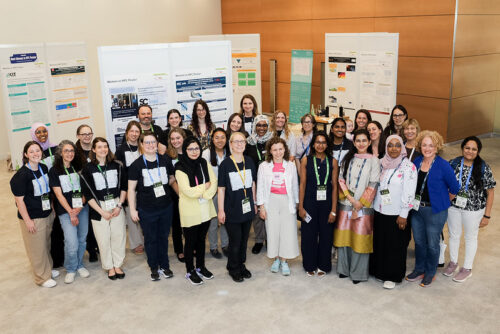
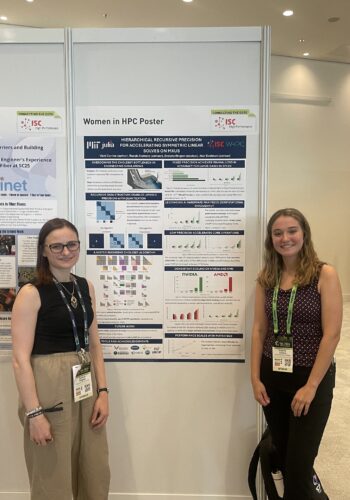
The Women in HPC (WHPC) community and Travel Fellowship made this international leap feel far less daunting. Their support began well before I boarded my flight. Reviewers provided thoughtful feedback on my poster that helped sharpen my technical communication, and an online pre-conference webinar gave us a dedicated space to practice our 90-second lightning talks and receive real-time feedback. This assistance meant that by the time I arrived in Hamburg and met community members in person, the initial nerves had transformed into excitement.
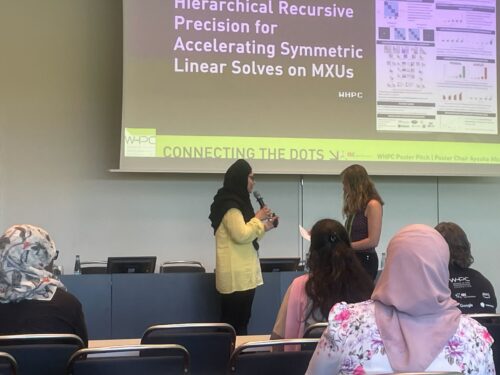
When it came time for the actual lightning talks onstage, the atmosphere was incredibly supportive. All the WHPC poster presenters cheered one another on, and the crowd was engaging and respectful. That same energy carried over into the poster session afterward. I was able to have so many conversations about my work with industry and research professionals, make connections, and even discuss a potential future research collaboration with a fellow WHPC presenter!
Attending the conference would not have been possible without the WHPC Travel Fellowship. The financial support allowed me to immerse myself in the technical program at ISC, learning from and connecting with research professionals as I prepare to apply to PhD programs this fall. Throughout the week, I attended sessions on mixed precision and GPU acceleration, and the Rigorous Evaluation of LLM Components in HPC Research tutorial provided insights I was able to apply to my current summer project at my lab.
One of the highlights of the conference was watching one of my advisors, Evelyne Ringoot, present her work during the Performance Optimizations on GPUs paper session. One of the things I value most about my research group is how consistently we support one another, and ISC was no exception. Evelyne attended my poster presentation, and we also had the opportunity to attend several technical sessions together throughout the week.
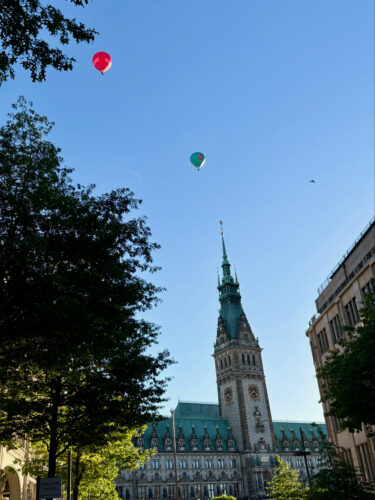
Beyond the conference center, I had the chance to explore Hamburg, experience German culture, take long evening walks around the city (one night I even saw hot air balloons floatingover me near Hamburg City Hall!), try new foods, and soak in the atmosphere of watching the World Cup in Europe.
My week at ISC was a rewarding mix of technical learning, professional presentation experience, and connection. The collaborative energy on the conference floor was contagious. Hearing others passionately communicate their work also sparked new ideas and future directions for my own research. The experience reinforced that, even as an early-career researcher, I belong in these spaces and that having a community like WHPC supporting you can make all the difference.
I am very grateful to WHPC for making this trip possible. If you are a student or early-career researcher who is nervous to submit your work, I encourage you to take the chance. The momentum, confidence, and connections you gain are absolutely worth it.
About the Author
Vicki Carrica is an undergraduate at MIT studying Computer Science & Engineering and doing research at the Julia Lab. Her research focuses on the development and optimization of high-performance linear algebra routines, with a focus on GPU acceleration and efficient algorithm design for modern computing architectures.