ISC26 Sofa Talk: Are we asking the right questions around women in HPC?
At ISC26 in Hamburg, a WHPC Sofa Talk brought together people from across the HPC community around a familiar question: How do we attract more women to careers in HPC?…


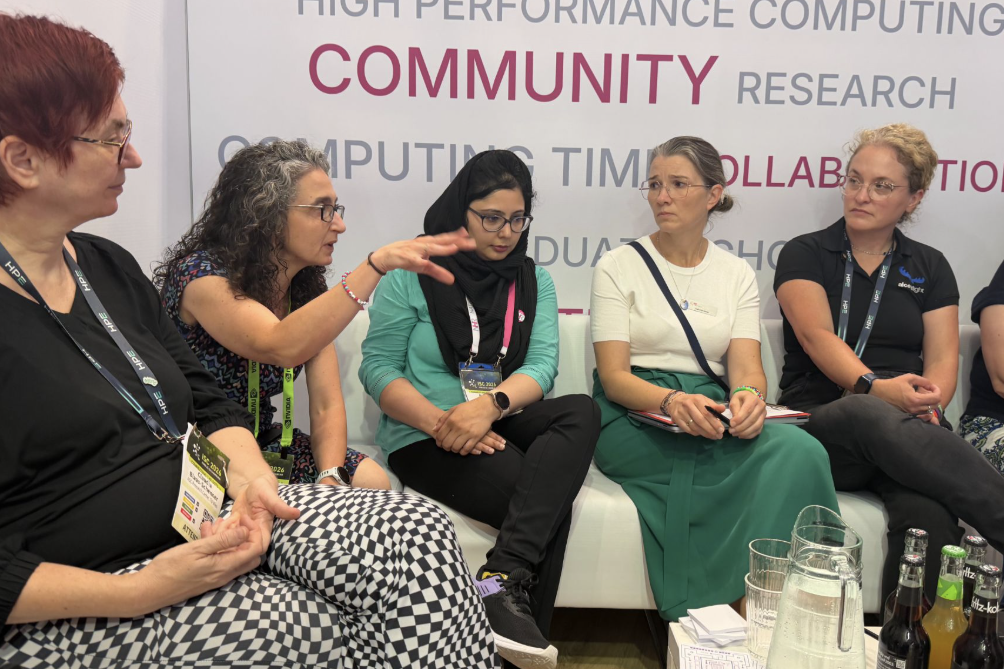
At ISC26 in Hamburg, a WHPC Sofa Talk brought together people from across the HPC community around a familiar question: How do we attract more women to careers in HPC?…

Finding Travel Support to Attend SC26 The International Conference for High Performance Computing, Networking, Storage, and Analysis (also known as “Supercomputing” or “SC”) takes place in November each year. This…
Crossing Continents, Finding Community: My ISC Experience with WHPC by Vicki Carrica As an undergraduate researcher, preparing for a major international conference is just as nerve-wracking as it is exciting.…
swipe for more
Attending the EQUATE Scotland event about Women in STEM and Feminism on 4th November was the perfect way to end a work week in my notoriously male-dominated STEM field . It was a fun and informative evening full of ideas and concerns about women’s (and men’s) views on feminism and women’s position in STEM. The…
Details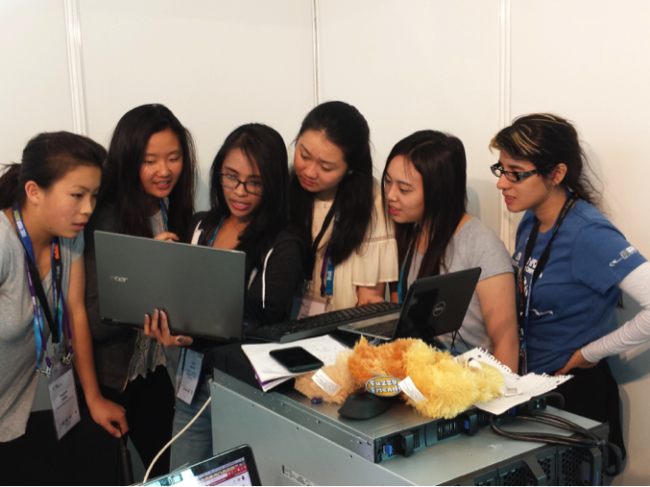
[section background_repeat=”repeat” background_position=”center top” background_attachment=”static” background_scroll=”none”] [/section] By Rebecca Hartman-Baker, Acting Leader of User-Engagement Group, NERSC, Berkeley Lab I recently gained some notoriety by coaching a team of six high-school and college-age women to compete in the Student Cluster Competition (SCC) at ISC. It was the first-ever male-free team in the history of the ISC competition.…
Details
[section background_repeat=”repeat” background_position=”center top” background_attachment=”static” background_scroll=”none”] [/section] By Kelly Nolan, Compute Canada Executive Director, External Affairs and Compute Canada’s Women in HPC Chapter Click here for more information about the Compute Canada Women in HPC Chapter Give this a try: Type “woman and computers” in Google Images. Included among the first images to appear are a…
Details
By Marie-Christine Sawley, Ph.D; Director of the Intel Exascale Lab in Paris This post first appeared on https://itpeernetwork.intel.com/ on 13 June 2016. Technical professions still attract more men than women, and high performance computing (HPC) is no exception. Although there are growing numbers of women working in the diverse areas of HPC, women as a whole…
DetailsGuest post by Maria Klawe, President of Harvey Mudd College. [one_sixth valign=”top” animation=”none”] [/one_sixth] [two_third valign=”top” animation=”none”] [/two_third] [one_sixth_last valign=”top” animation=”none”] [/one_sixth_last] Heres how we did it This article first appeared on BackChannel on 26 February 2016. I’ve been passionate my whole life about getting more women into technology careers. After 40 years as an…
Details
[one_sixth valign=”top” animation=”none”] [/one_sixth] [two_third valign=”top” animation=”none”] [/two_third] [one_sixth_last valign=”top” animation=”none”] [/one_sixth_last] The annual SC conference is the “go-to” event for innovation in our community, but for those focused on the development of a robust future computational workforce, one announcement in particular stood out at SC15: creation of the ACM SIGHPC/Intel Computational and Data Science…
Details
Guest post by: Daniel Holmes, EPCC and Chair of EuroMPI 2016. EuroMPI 2016 and Women in HPC are delighted to announce the first partnership between Women in HPC and a High Performance Computing Conference. EuroMPI is the pre-eminent meeting for users, developers and researchers to interact and discuss new developments and applications of message passing parallel…
Details
By: Toni Collis This blog post is a transcript from Toni Collis’ speech at the launch of the GRACE HPC service at UCL, April 2016. I’d like to begin with a question. It’s the question that drives us. What percentage of registered Grace users are women? A: 43% B: 22% C: 12% D: 5% The…
Details
One of the reasons why EPCC set up Women in HPC is because we recognised there was a problem. The problem was the apparent lack of women in the supercomputing community. When my colleagues and I started Women in HPC, our purpose was very clear: to recruit and retain women in the international HPC workforce.…
Details
By Simon Hettrick, Deputy Director, Software Sustainability Institute I’ve attended a lot of events during my time in academia, but I can think of only one where women outnumbered men (one of the BSA’s Science Communication Conferences). This is not a revelation, of course. It’s well known that women are poorly represented at events: as…
Details
[section background_repeat=”repeat” background_position=”center top” background_attachment=”static” background_scroll=”none”] [/section] [section background_repeat=”repeat” background_position=”center top” background_attachment=”static” background_scroll=”none”] Raquel Alegre I work as a Software Developer at University College London in the Research Software Development Group where we collaborate with researchers across campus, covering fields from Ancient History to Astrophysics, to facilitate their research by improving the quality of their…
Details
Guest post by Alex Simperler, NSCCS, Imperial College London. Intrigued by talking to Toni Collis of “Women in High Performance Computing” who are working towards equal representation in HPC, I started to question how “equal” we are in Scientific Application Software usage. The NSCCS – short for EPSRC National Service for Computational Chemistry Software –…
Details